


IgorF
-
Posts
283 -
Joined
-
Last visited
Content Type
Profiles
Forums
Blogs
Media Demo
Downloads
Gallery
Store
Everything posted by IgorF
-
while thinking about feasibility of adding back some bakery into my diet to substitute fruits partially I used to do some free search and unexpectadly landed into a book "Nutrition, Food and Diet in Ageing and Longevity" Springer Nature, 2021 from which I became curious about the research done by Grant Rutledge (https://journals.plos.org/plosone/article/file?id=10.1371/journal.pone.0240132&type=printable) which focused on so called Hamilton's hypothesys (which supports a lot of observations and recommendations about dietary choices in the midlife given in some sane books like those by Fontana and other respected authors). In a few words - after 40 years of selective experiments on melanogasters it looks plausible to hypothesise that "ancestral" diet (the one adopted 90%+ of the species timeline) could be preferential from the midlife in comparison to the novel one of the recent generations. Here is a talk on the topic: I wonder if somebody from the long-term practitioners have own data on inflamation markers being on a healthy diet with grains/cereals and without them, offcourse no artificial "foods" or keto regimens and other known modifiers (e.g. huge o6 intake that could also interfer). The experiment could take many months, thus it could be useful to learn other's anecdotes on the topic. UPDATE: a systematic review on crp and il6 markers during grain/nograin studies https://pmc.ncbi.nlm.nih.gov/articles/PMC8778110/ (seems in all the experiments it does matter what was the type of diet, some have clear zero effect and some halves the markers easily)
-
just 2 cents on primate studies and conclusions for humans, I came to similar some time ago and now I've found them in a compact lecture form in The New Science of Healthy Aging (https://www.amazon.com/New-Science-Healthy-Aging/dp/1094077011) The conclusion in the chapter on monkeys/apes and us in brief - we evolved to be much more prepared for constant movement (but not intensive sports, just be active several hours/day) and the price for it - our bodies are damaged by our metabolism if we live the modern way (with its food and modus operandi). The key to understand this (one of the most importnant) came from Hadza studies (+similar for other last available then natural people) and a discovery that they do burn the same energy as a modern person (not with extremely expanded body!) but their energy seems is spent differently (including creation of less molecule types that do the harm in studied ways to the body). IMHO it is better to live that way in any case, trying to keep the smallest healthy bodyframe from the very beginning of life (no dairy in younger ages!) because striping the body later will not switch all the complicated interacting networks of metabolic complexity to their best possible result (the familiar one that is limited by 120 years but seems only for small people, e.g. 140-160cm usually and never expanded to unhealthy weight zones). Br, Igor
-
crsociety.org FINALLY got back online after 4 months
IgorF replied to Alex K Chen's topic in Chitchat
Thanks a lot for making it back! Br, Igor -
Hm, for the sake of curiosity googled for it again Carnosine and advanced glycation end products: a systematic review https://pubmed.ncbi.nlm.nih.gov/29858687/ the only meaningful thing from it (invitros, animal studies and so on is not interesting, they are pre-pre-preliminary things before making any conclusion about reasonability for later decisions on human studies) is this one l-Carnosine supplementation attenuated fasting glucose, triglycerides, advanced glycation end products, and tumor necrosis factor-α levels in patients with type 2 diabetes: a double-blind placebo-controlled randomized clinical trial https://pubmed.ncbi.nlm.nih.gov/29420997/ Here what really matters is the dose - 1g and the participants - people with considerably higher blood glucose. The overall decrease in the blood glucose level of 13 mg/dl for diabetics is while significant speaking honestly is not a big gain. What does it mean? There is no magic mechanism suspected to be present, it is stochastic molecules contact that made it, lower dose of the drug will make it even more insignificant. For people with 2 times lower glucose levels (=no diabetes) 2 times lower drug dose will make the overall result indistinguishable from fluctuations caused by normal life circumstances. And that is not discussing if AGEs created by consuming good diet without longterm calories extra are so unwanted. The story is not different comparing to other "beneficial" molecules, the strongest are demonstrating the same statistically significant effect in therapeutic doses (e.g. 3g of omega3 on lipid profile and stories like that) and that makes me very skeptical about them. Taurine mentioned above has orders of magnitude more published studies and is cheaper to be implemented into a daily routines (perhaps just to calm down the anxiety generated by the "longevity" hypesters everywhere novadays - no irony, a plausible approach from the psychological perspective). At the daily price of 50g of sprouts or a handful of berries I think carnosine is not worse it. Br, Igor
-
I've taken it for several months due to curiosity, discovered no effect of any kind and dropped it as one more useless stuff. IMHO it was a popular recommendation in the health-n-wellness books industry of 200x and popularity declined after these years. Short term controlled studies show no effect, even for not very healthy people, where it is expected somehow e.g. https://www.mdpi.com/2072-6643/15/22/4835 From my intuitive understanding for it to work it has to be precisely targeted at the brain cells that could benefit from it but there is no delivery vehicle that could do it in a "kanban style", the same as with many things named "promising". Br, Igor
-
while listening to a (journalist written, not scientific but seems ok) fresh book on glp1 drugs (https://www.amazon.com/Magic-Pill-Extraordinary-Disturbing-Weight-Loss/dp/0593728637) I was surprised to discover sarcopenia risks on these drugs that are despite of different mechanism comparing to previous generations of drugs causes so similar muscle loss. Author mentions that in his 40ies he pairs weight-control drug usage with excercising but those who aren't doing the same / or ineffective for any reason should take it into account since this effect is undesirable (if it is not a kind of "eat more protein" kind of thing like e.g. https://www.healthline.com/health-news/ozempic-muscle-mass-loss)
-
And another interesting quot from the book, not related to dogs but to the topic of body size and longevity: this was about things not so murked out by very aggressive tactic adopted (and further developed) after tobacco war by "food" industry now to promote novadays body ideal, so sheds some light on data about excercising at athletes grade but in the age when there was no modern chemistry tricks and excercising was more focused on "to be" rather than "to look like", how unhealthy it could be now is an interesting question.
-
It is a bit tricky to quot the book due to its restricted availability online (it seems possible to buy it via google store but not in my location, so I bought a used paper one and searching for direct quotes on scanned one avaible at google %)) https://books.google.com/books?id=PCU0RwDI6c4C&pg=PA90&lpg=PA90&dq="compared+to+americans,+when+okinawans+suffer+heart+attacks"&source=bl&ots=sCULWlG8Vj&sig=ACfU3U3JANqac5XkSnX1j7TMPH1-oyLl4A&hl=en&sa=X&ved=2ahUKEwiwyrrBlpeGAxXKXvEDHQb8AQ4Q6AF6BAgPEAM Elderly Okinawan men and women are also short and have the smallest physique of all Japanese. Compared to the taller population on the mainland, death rates from stroke and heart disease are over 40% lower. The annual death rate per 100,000 people from CHI) is 18for Okinawans vs 102 for Sweden and 100 for the US. Stroke mortality is lower than that ofSweden, Italy and Greece but 25% higher than for the US. However, Willcox et al.(2004)found the elderly Okinawans had exceptionally young arteries and low blood homocysteineand cholesterol levels in comparison to Westerners.The heights of the elderly (75 to < 100 years) average 158.5 cm for males and 144.8 cmfor females (Chan et al., 1997). However, centenarians are substantially shorter and average148.3 cm for males and 138.6 cm for females. Compared to Americans, when Okinawanssuffer heart attacks, they are more than twice as likely to survive. However, recent healthtrends are not good due to changes in diet, lifestyle and body size, and younger Okinawansare seeing substantial increases in heart disease. (the paper mentioned in the text is Dietary, anthropometric, hematological and biochemical assessment of the nutritional status of centenarians and elderly people in Okinawa, Japan. DOI:10.1080/07315724.1997.10718679 "scihubbable") Actually the whole book chapter is interesting, with much more data from different studies of different things, sometimes with peculiar graphs like:
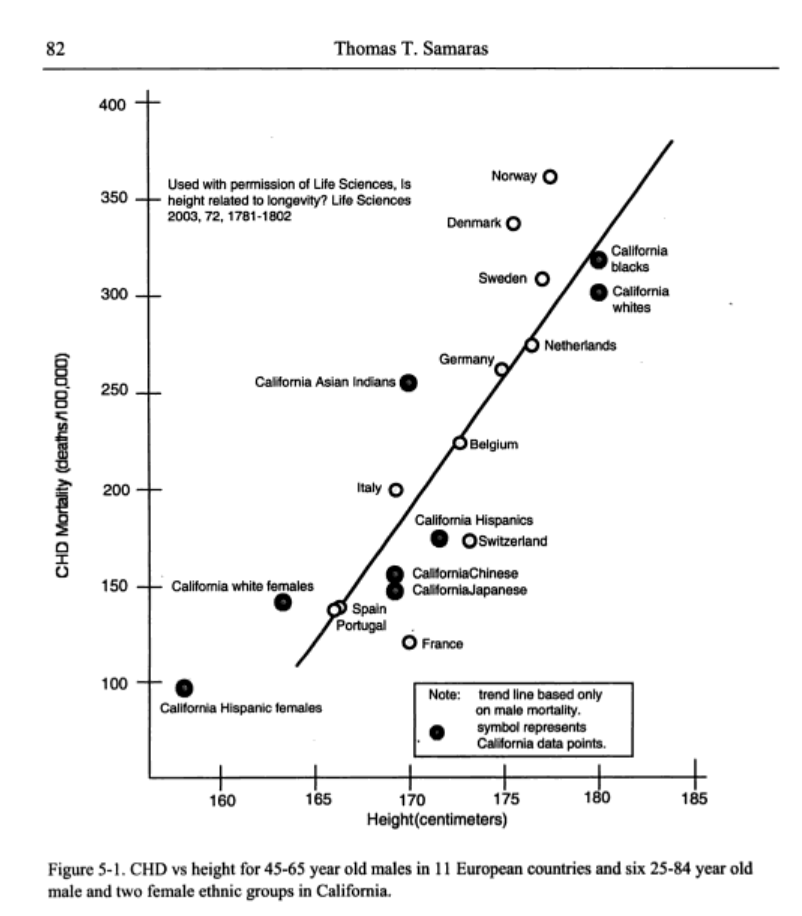
-
A curious review, no idea if it is not a kind of "eat more" conditioning: https://journalofmetabolichealth.org/index.php/jmh/article/view/78/242#CIT0060_78 Sometimes I think about pendulum, since it has moves "to the right" and "to the left" then a lot of things without a careful quantitative analysis (e.g. there are 40 studies that proves "a" without saying that there are 4000 studies that proves "non a" - who knows how many of them are in reality and what power they have in total, e.g. not just plain quantity but with weight coefficients) could be easyly used as manipulative language constructs (it moves to the left! it moves to the right! more research is required!) and this is heavily used in marketing of almost all we anyhow consume. From my observation I sometimes have acne after sudden evening overeating of carbs-heavy meal but I never tried to link it with salt, given a hard possibility to assess its real consumption. Generally, the stricter I am with evening energy - the less chance for acne to appear. On the other hand - I assume there should be a large group of people that do not benefit from low salt diets and for them perhaps it makes no sense to try to go down far from 3g/day for the sake of "safety", who knows to which levels their ancestry was tuned long time before (but 7g is also a bad idea, no natural tuning for such a value seems ever happened with homos). Br, Igor
-
Hm, their data for those exceptionally long-lived fits very good into a strangely underestimated allometric angle of view that is thorouthly described in a book (Human Body Size and the Laws of Scaling: Physiological, Performance, Growth, Longevity and Ecological Ramifications. Edited by Thomas Samaras; contributions by, Andrzej Bartke and, C. David Rollo.) by one of the proponent of this angle Thomas T. Samaras (he claims that he analyzed approx. 5000 of different data sources and just has no way to mention all of them in the book refs for obvious reasons). The conclusion in the book as a kind of redline in it (imho) - do not grow big at all, no matter if it is adipose hyperaccumulation or culturally-imposed desire for higher stature (but low height due to malnutrition or other unhealthy reasons is not desired offcourse). Do not grow fast - those who experience acceleration ("catch up growth") have more health troubles. This was suddenly unexpectedly (for me) echoed in the fact described in a nice book about trees "The Heartbeat of Trees.." by Peter Wohlleben - the longevity championing amongs trees seems also requires to grow slowly. The same is for sex - allometric data for the dogs mentioned shows the same sex dimorphism for males/females and this describes the longevity chances for them the same way as for humans - females do have less body frames, lower igf1 and so on. Actually the interesting thing about blue zones is that their inhabitants were almost all low-framed, that is itself lowers the unwanted load of igf1, ldl risks, ros-related stress and so on and so on. And the most exciting thing for me is that all this stuff was already known for a long time but the last two decades it completely murked out, left in rather scientific books and papers and is not visible due to a huge amount of misleading "explanations", probably forced by "eat more" of a "good stuff <forced variable>" promoters and newer media frenzy powered by the tools available now. Br, Igor
-
calibration study on a 12k cohort, for those who wants to match own data against others' https://www.mdpi.com/1424-8220/24/3/744
-
Is Low LDL Bad For The Epigenetic Pace of Aging?
IgorF replied to Mike Lustgarten's topic in General Health and Longevity
The idea is - thinking about flux and seeing the liver as a production facility, with a quantitative angles regarding processing and storing capacities. There is surely a detection mechanism (perhaps many of them) that spins up all the complicated machinery to orchestrate the output. When detector will rise the "high watermark" (that could also be rised for prolonged period) then the cargo output part of the machinery will prepare and spill out cargoes as soon/often as possible, thus sometimes exporting an unoptimally packed ones - these famous small dense ldls. In other words - the effect is not to make all the cargoes smaller but to make more cargoes and there will be considerably bigger share of smalls amongst them. In non enginerring language the same idea is - do not allow the detector to "see" the abundance, but do it is a natural, not "hacking" way, e.g.: https://www.ncbi.nlm.nih.gov/pmc/articles/PMC9025822/ Of all the things mentioned I personally think only the first two are really matters and have a long-term effect, starting from the word excercise is almost useless for the goal. The same for sat/unsat comparisons that brings some difference and so on, energy overdoing will diminish any tricks because it acts on all 37thrillion of body cells and there is neither exist nor will ever be engineered way to do something with it, switching off some part of machinery in one place will force the flux to dig the holes in another areas. Br, Igor -
Since I consume a negligible amount of cacao and chocolate last year (up to 15g/day) and this is less then previous years I expected to move my test data to the lower side but instead of it I now have borderline 0.2 ug/l instead of 0.13 almost 2 years ago. Maybe because I switched to cheaper noname sources due to my believe that it makes no sense to pay 2.5 prices for better ones. Or maybe the reason is in something different (I ate 1.5kg of unknown quality stuff like spices/curcuma/ginger/cynamon last months also). In any case, I was curious to find that japanese people (and probably other far east populations with rice as a staple food) do have very high cadmium (often ~40% of nephrotoxic values!) levels in the kidneys, here are a few pages on it (I hope google will allow them to be viewed): https://books.google.pl/books?id=sSoUDgAAQBAJ&pg=PA171&lpg=PA171&dq=It+is+widely+known+that+an+outbreak+of+itai-itai+disease,+a+human+disease+caused+by+local+Cd+poisoning+fromintensive+mining+operations,+occurred+in+Japan+more+than+50+years+ago&source=bl&ots=adM4kCU5R-&sig=ACfU3U0STYIwmiAGLMW16Q0gr617544_RQ&hl=en&sa=X&ved=2ahUKEwj9g-virMmFAxXJHxAIHUmNClMQ6AF6BAgmEAM (or doi of the chapter 10.1016/B978-0-12-805378-2.00013-9 is also possible to be fetched via sh) Given the fact that japanese are among the leader top for longevity the fact could be peculiar I would say.. Br, Igor
-
Supplements that might counteract the effects of CR
IgorF replied to BrianMDelaney's topic in CR Science & Theory
When listened to the audio version of Coleen Murphy's "How We Age" book I was surprised by an effect observed in flies, a brief on it is here https://www.scientificamerican.com/article/the-scent-of-a-calorie-wh/ https://www.cell.com/fulltext/S1534-5807(07)00064-0 I can't find the mentioned study from 2017 but it seems there are more studies about the olfactory influence on well-known regulatory paths, e.g. the refs of https://www.sciencedirect.com/science/article/abs/pii/S0962892423002349 and so on. So it could be the case that not only the meds and lifestyle stimulating the growth-related machinery could, well not cancel the CR effect in more complicated organisms like mammals but dempfer it (imho to a small degree if any) but also intense enough stimulation by some flying chemistry. Given that we assess the olfactory as a separate sense but from the buildup perspective it is rather a part of a wide sensory continuum wired into the brain the idea is completely ok but I am skeptical about the size of the effect (and easiness of CR/DR cancellation via other factors) due to the complexity of mammals in comparison with more primitive organisms - the same basic building blocks that are dealing with materia and energy transformations have less degrees of freedom due to their incorporation into much more complex structures (this is the reason we can't see 30-100% lifespan increase from CR in mammals also). Br, Igor -
Previously I did not tested shbg rather focusing on thyroid and lh,fsh,pl,t pannels. After some reading it seems this one is paired with well studied main cr pathway of insulin/igf1 - it is suppressed by igf1 that itself is increased with insulin. So my context is: - definitely CR, unfortunately paired with some weight loose in the last 3 months, I am crossing now the "low normal" bmi range - borderline hematocrit, etc; low normal leukocytes without neu/lym disporoportions, reticolocites reveals no upcoming anemic decreases - good proteinogram with a lot of albumin, I assume I have all available protein being used for desired goals, no growth etc. - from "traditional" clinical anemia signs perspective only leg weakness when going 100-200 stairs up is present in some mild degree - low protein diet, 10% and plants only, this seems forms igf1 value independently of "raw" insulin arm So the results observed are: insulin 2.3 in 1.9-23 mU/l igf1 88 in 53-215 ng/ml shbg 74.3 in 10-57 nmol/l total testosterone 208 in 150-684 ng/dl dihydrotestosterone 141.2 in 143-842 pg/ml To derive some insight on free testo or bioavailable testo (the concept is not widely agreed as important, more in a dedicated book "Controversies in Testosterone Deficiency" - Springer 2021) I used this calc https://www.issam.ch/freetesto.htm Albumin 4.9 SHBG 74.3 Testosterone 208.2 Free Testosterone 2.18 ng/dL = 1.05 % Bioavailable Testosterone 57.9 ng/dL = 27.8 % (this is with the lowest albumin I ever tested, last values were higher giving freeT 1.03-1.01%) Resuming - I would say that the expectation to have high shbg due to low igf1/insulin is observed, and lower available testosterone due to high shbg is what has to happen from all points of view (it seems a safeguarding element - so no cell growth stimulation by testo will happen when resources are low). Br, Igor
-
Hm, trying to listen to the stuff of https://www.youtube.com/@SeriousScience in particular so far looks like a good source of inspiration, the channel has a lot of materials of many kinds thus I can't conclude about all the stuff but it looks like a high quality popsci to do my morning salad chopping %) Br, Igor
-
Not a lecture but rather a roadmap of Leonard Hayflick's scientific trajectory, with lots of nuances not visible in the books and papers, I found it very interesting from many angles: Br, Igor
-
Is Low LDL Bad For The Epigenetic Pace of Aging?
IgorF replied to Mike Lustgarten's topic in General Health and Longevity
IMHO the situation with abnormally low LDLs originates from the approach of contextless data sciencing and creates unwanted confusion due to this. For myself I use this model to understand it (or "understand", for obvious reasons of complexity). There is a flux of materia into a sophisticated transforming machinery called liver. There is a processing capacity with optimal range of operation let's say 40-90% of approximated saturation point. With such a flux the size of exported cargoes will be determined by many factors but most of them will fluctuate close to mean values observable in the population. If we will artificially increase the flux at the input then the system will leak the extra to some other paths (if they exist and to the extent of their saturation) or will start to export lower sized cargoes, just to get rid of overload because there is no housing for it (yes, there is some and fatty liver is a sign of saturation of this backup mechanism). So actually it is pretty imaginable within the queing theory used in engineering. There is a rare exceptional share for small abnormal cargoes - genetically determined, these people will produce abnormal particles within a normal flux values but my intuitive feeling is that they account for minuscule shares of a percent. In other words - for most of the people the start of production of smaller particles is a redflag about unwanted input overload that itself is a sign that a lot of problems will come in other areas - the network of queues goes deoptimized and no one could predict where the things will start to break. No magic pill or any kind of mimicking or biohacking will help, there is no way to mimic normal traffic in a congested network, there should be incoming rate limit implemented until it will become too late and parts of the mechanism will be deformed. From this perspective it does not make a big difference if smaller particles are more atherogenous themselves, this adds to the bad prognosys but should be of concern especially for those with rare unfortunate genetics, 99.9% of other people should rethink their energy balances. Br, Igor -
Coleen Murphy in her recent book "How We Age: The Science of Longevity" mentions it many times - the less children - the better woman's chances for longevity. It should be easy to derive this from the fact that igf1/insulin-related areas heavy involvement in fetal and post-natal growth (https://www.ncbi.nlm.nih.gov/pmc/articles/PMC5779855/) will not left unnoticable for her body also.
-
I just finished listening to the most of his episodes during morning salad preparation. It took me many months to do so. I came to conclusion that it is a typical "amusement with a fleur of science" with 90% of useless information that nevertheless could sometimes raise curiosity about something (or about a guest) and that way feed the later search. The bad side of it - it is filled with "science supported sales" process (not only direct ads), so unprepared listener will sooner or later have a lot of b....t in his/her head. With time it became worse, both for topics and for promotions (eat more "high quality" protein for me is a 100 bulletproof red flag after reading of "Food politics" by Marion Nestle, so I dropped it completely to stay calm%)). I wonder if there is some true version of a long running really scientific podcast that could be picked and listened regularly (? https://www.scientificamerican.com/podcasts/), so far only pop-sci audiobooks are useful but they are monologs and sometimes a discussion between highly knowledgeable people could bring valuable things almost never described in a book form. Br, Igor
-
Hm, cronometer reports for me the top contributors for today like: Paprika 592.8 mg 17% Oranges, Raw 570.2 mg 17% Honeydew Melon, Raw 513 mg 15% Apple, Fresh, With Skin 443 mg 13% Grapes, Raw 416.4 mg 12% Red Bell Peppers, Raw 405.1 mg 12% Chicory Greens, Raw 394.8 mg 12% Strawberries, Raw 355 mg 10% Dates, Dried 347.7 mg 10% Napa Cabbage, Raw 347.5 mg 10% with total 8820 mg 259% (in reality I have more, e.g. from 6 spoons of tomato passata for which cronometer has no values reported) For the sake of curiosity just selected all the leafs/greens/cruciferous stuff for a day - almost 2 grams of potassium comes from 600 grams of it. Br, Igor
-
Hm, for the reasons unclear for me just decided to look again into the original paper this thread started with. https://www.ncbi.nlm.nih.gov/pmc/articles/PMC10630957/ They used rather a therapeutic dosage for their experiment: To get to the human data I used this https://www.jkom.org/upload/31-3 01 [01-07].pdf which for a 60kg human is close to 5g daily dose, no idea if it will create serum concentrations close to the observed in the young people. Also there is an interesting addition by authors: That could be interesting because they do not reveal the reasons they are noting) I personally do not want to eat 5g of taurine daily to increase the gradient enough that it will help to push the taurine to the brain areas because I have 2-2.5 times the lab normal range (however reliable the norm is in this case) with a "small tongue of a teaspoon" dose (I assume 200-300mg) of it. But invention of a kind of molecular "jit/kanban" for it will make it more attractible. As well as other molecules that were promising but after decades still producing results almost indistinguishable from nothing. Br, Igor
-
Supplements that might counteract the effects of CR
IgorF replied to BrianMDelaney's topic in CR Science & Theory
Hm, shouldn't it work two ways - since there is nothing that could really mimic CR (I don't believe anybody who spent enough time doing own research really believes there are such things with noticeable effect) then it is the same unlikely that there exists some substance that could really break the CR. The reason - CR has systemic effect on the whole body which originates at the very low level (on every cell but to a different degree). I am cutting out obviously bad things like artificial metabolism speedup drugs which are not 100% safe for non-CR persons also. The same is for other known to be bad things, etc. Or I am using too simplistic approach and there are known details with a solid ground that has to be taken into account? Br, Igor -
I am using small amounts (10g) of cannaflour in the salads the same way as other powder stuff. Just because it is cheap and formally nutritious, however I have doubts about nutrients availability using it that way. In any case it shouldnt make any harm thus worse to play with.
-
Telomere Length Is Associated With Dementia Risk
IgorF replied to Mike Lustgarten's topic in General Health and Longevity
yep, I already mentioned this in /topic/18574-different-organs-age-at-differrent-rates-attempts-to-estimate-organ-age/ Actually the knowledge about different speed of aging in organs is not something new, Hayflick for his book on aging used so called Baltimore study (BLSA) as a huge source of good quality information that reveals this fact. The problem is that for an individual person all this stuff being discussed novadays (often originated from "contextless data sciencing") together with all the scores and clocks and other similar stuff is rarely actionable, if at all. Also 70% of deaths appears to be somehow cardiovacular and up to 80% of them is named sudden (https://www.ncbi.nlm.nih.gov/books/NBK507854/) with aging of the heart itself or intima media or growing disfunctionality of the immune system or (a long list of other known things) not mentioned at all. People with "overused" heart that is "aged" faster due to ultramarathons do not show some big difference in an earlier deaths due to heart (some anecdotes are known but statistically they are not significant AFAIK). Thus as with other statistics-based things - it is useful for organisations in planning their resources and is less useful for an individual in personal behavior and risk planning (well, sometimes useful to some small degree). But almost nothing new and actionable for an individual comes from these popular now constructs, at least yet. Maybe they will mature to something but it will take decades (as with HRV - it is something researchers discovered in 80-90es as potentially useful as a tool but it is still not ready to be a solid ground for individual usage, despite of being productized heavily within fitness areas).