


Dean Pomerleau
-
Posts
3,442 -
Joined
-
Last visited
Content Type
Profiles
Forums
Blogs
Media Demo
Downloads
Gallery
Store
Everything posted by Dean Pomerleau
-
crsociety.org FINALLY got back online after 4 months
Dean Pomerleau replied to Alex K Chen's topic in Chitchat
Archive.org does a good job capturing format and linked images: https://web.archive.org/web/20230921223251//topic/11488-cold-exposure-other-mild-stressors-for-increased-health-longevity/ It even seems to do a good job with the video (!???) near the bottom of the page. It doesn't appear as the standard YouTube video player like it does on the original page, but I can't imagine archive.org is actually caching a copy of the video. Not sure though. -
crsociety.org FINALLY got back online after 4 months
Dean Pomerleau replied to Alex K Chen's topic in Chitchat
This thread has a bunch of images mostly linked. /topic/11488-cold-exposure-other-mild-stressors-for-increased-health-longevity/ -
crsociety.org FINALLY got back online after 4 months
Dean Pomerleau replied to Alex K Chen's topic in Chitchat
Will your scrape capture images in posts too? -
crsociety.org FINALLY got back online after 4 months
Dean Pomerleau replied to Alex K Chen's topic in Chitchat
Sounds good Alex. What are you going to do with the scraped data once you've got it? -
crsociety.org FINALLY got back online after 4 months
Dean Pomerleau replied to Alex K Chen's topic in Chitchat
If you want it done and have the technical chops, I suggest you go ahead and do it. I think it highly unlikely anyone else will. Heck I still haven't been able to find out who brought the forum back online and who is paying to keep it that way. I wouldn't be surprised if it went away for good without any notice. -
crsociety.org FINALLY got back online after 4 months
Dean Pomerleau replied to Alex K Chen's topic in Chitchat
As I recall, the CRS had plenty of money in it's bank account to pay hosting costs for many years, assuming someone has been able to tap into it again. BTW, I still haven't heard back from anyone (Brian, Michael, James, Bob) about the plan for going forward. -
It looks like my kind of movie. I'll try to convince my wife to watch it.
-
New Yorker profile of his megalomania from 2016: https://www.newyorker.com/magazine/2016/10/10/sam-altmans-manifest-destiny
-
Jim, I'm not sure what the critique you posted was trying to get at, but I will point out that it was written in 2017 about this 2016 paper in Nature by different authors: https://www.nature.com/articles/nature19793 Olshansky's 2024 paper in Nature Aging that I pointed to: https://www.nature.com/articles/s43587-024-00702-3 uses different analysis and comes to a similar conclusion - i.e. the rate of increase in life expectancy has been modest and decelerating in recent decades. The Vaupel paper I saw uses longevity data from the Guinness World Record database, which has issues, as pointed out by the critique you linked to. Here is the graph of oldest living humans over the years from Guinness that Vaupel based his analysis on: You can say the graphs are slowly going up, but for men, the slope is only about 0.5 years per decade, and even that seems dubious if you look at the data since 1998.
-
crsociety.org FINALLY got back online after 4 months
Dean Pomerleau replied to Alex K Chen's topic in Chitchat
I haven't heard back from my inquiry to folks on the CR Board asking about how the forum came back online and what exactly is the plan with Longecity. I asked them if someone would post here share the details. We'll see if they do... -
Pretty much. That and the hope we'll remain healthy enough to take advantage of real life-extension interventions when they might one day become available.
-
Jim, Please read the Olshanky paper linked to above. It's entire topics was how lifespan gains have been asymptoting over the last few decades in developed countries. You can pretend that moderate CR and a healthy WFPB diet will greatly extend lifespan over the slobs who eat a standard American diet. But people like the Seventh Day Adventists who have a healthy diet and lifestyle live to ~90, not 110 or 120. See this post and references therein:
-
I envy your optimism Jim, but sadly diet/lifestyle improvements like avoiding fried foods aren't going to get you or anyone else (except perhaps one in a billion people) to live to 120, let alone 125-130. From the recent Olshanky paper in Nature Aging: Our analysis suggests that survival to age 100 years is unlikely to exceed 15% for females and 5% for males, altogether suggesting that, unless the processes of biological aging can be markedly slowed, radical human life extension is implausible in this century. Studies [1][2] have observed that between 100 and 110, a person's risk of dying is around 50% per year. Past 110, it rises to ~70% per year. If 5% of men eventually live to 100, that means one man out of 20 will become a centenarian. What is the likelihood one of those will live to 110? The answer is 0.5^10, or one in 1024. And the likelihood of one of those living to 120? The answer is 0.3^10, or one in ~170,000. Putting those three low probabilities together, the likelihood of a random man living to 120 is one in 20 * 1024 * 170,000 = one in ~3.5 billion, which coincidently is almost exactly how many men there are on the planet today. The only way anyone is going to live past 120 is if we figure out and fix the underlying causes of aging. --Dean [1] https://onlinelibrary.wiley.com/doi/10.1111/joim.12627 [2] https://www.ncbi.nlm.nih.gov/pmc/articles/PMC8279393/
-
crsociety.org FINALLY got back online after 4 months
Dean Pomerleau replied to Alex K Chen's topic in Chitchat
Hey Gordo! A little background on what happened. The CR Society treasurer David Stern died a while back (RIP). There was no transition plan and he was the only one with access to the CRS bank account and credit card. The bill for hosting the forum eventually went unpaid when the credit card expired. James tried several times, but as far as I could tell none of the remaining CRS Board members seemed able/willing to gain access to the money so we could start paying the bill again (I was CCed on the emails). I'm still not sure how the issue was resolved and who is paying the bill now. There is talk on the email chain about having Longecity.org take over hosting for a one-time payment from the CR society, but I'm not sure where that stands. I'll try to find out more. --Dean -
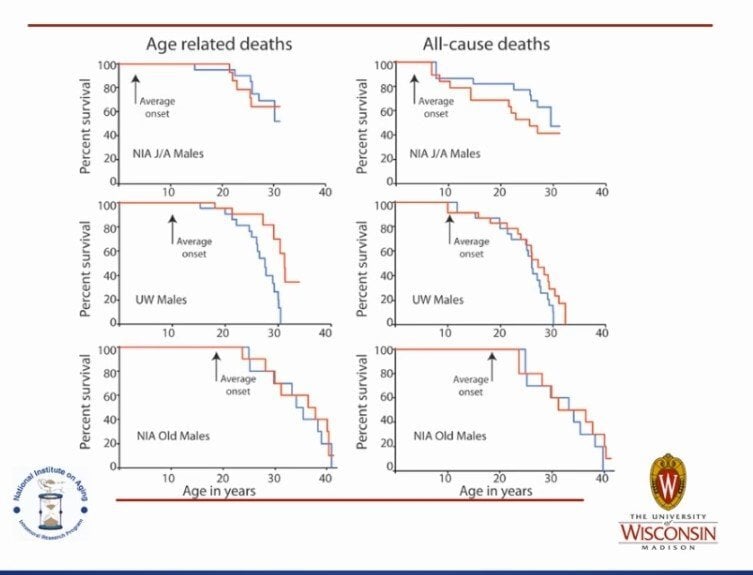
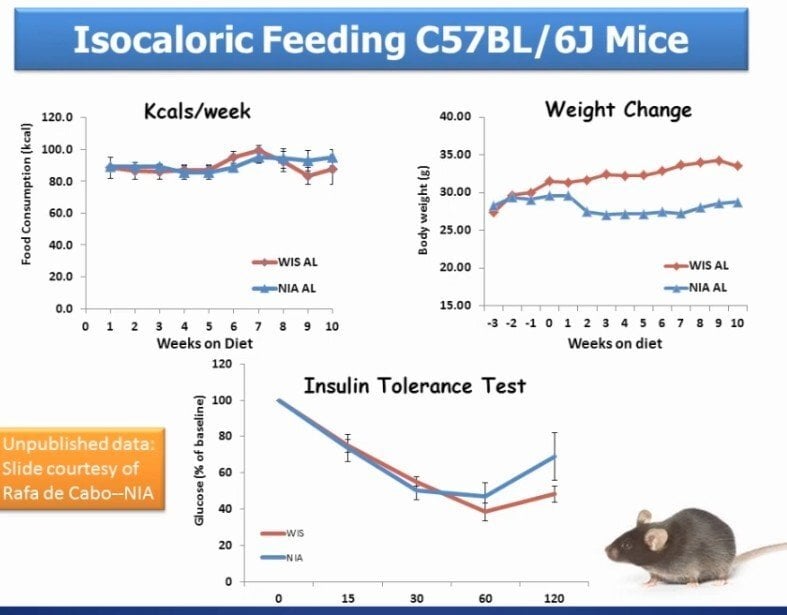
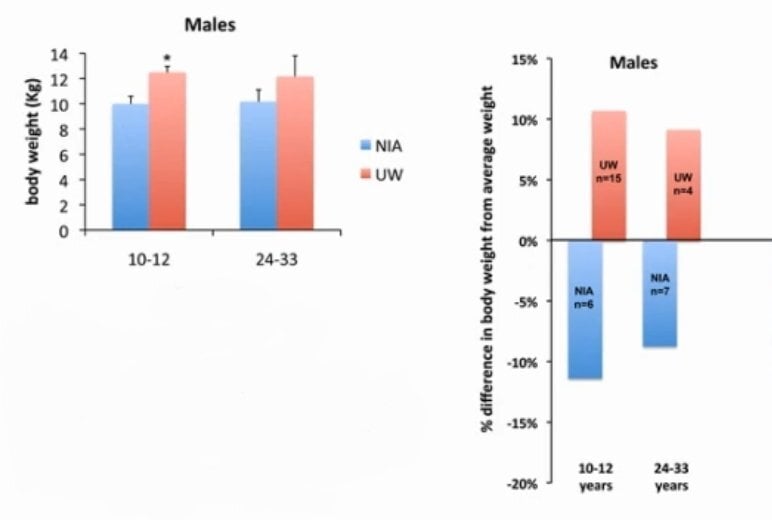
Jim, Here is a good video comparing the study design and results of the NIA and Wisconsin primate CR studies by researchers from the two organizations, which I hadn't seen before today: Here is a screen capture showing the mortality curves of the male monkeys from the NIA (top and bottom rows) and UW (middle row). The CR monkeys are in red and the control monkeys are in blue: If you look in the right hand column (all-cause mortality) and the bottom two rows (UW males vs NIA older-onset males) you can see both the controls and the CR monkeys from NIA had significantly longer median and maximum lifespan than did the CR (or control) male monkeys at UW. The older-onset CR males from NIA didn't appear to live significant longer than NIA old-onset control males, and even in the UW males, the CR monkeys didn't have impressively much longer lifespan relative to controls when looked at from an all-cause mortality perspective. Interestingly, they did a study where they fed rats with the exact diets given to the monkeys at NIA and UW, in iso-caloric amounts. The rats fed the (crappy) UW diet got much fatter and had worse insulin sensitivity than the rats fed the exact same calories of the NIA diet: This suggests to me that the high refined sugars and fats in the UW diet was likely pretty toxic, so by eating less of it, the CR monkeys lived longer than controls. When the toxicity of the diet wasn't a factor (i.e. in the NIA study), eating less of the diet didn't give much benefit compared with eating just enough of the (healthier) diet to avoid obesity. Not surprisingly, you can see from these graphs: that the NIA monkeys did indeed weigh less at several time points during the study than the (scrappy-diet eating) UW males. The graph on the right shows that the NIA monkeys weighed 10% less than the average rhesus monkey in captivity and the UW monkeys weighed 10% more than the average rhesus monkey in captivity. --Dean
-
Jim, Your positive personal results are entirely consistent with the science. Adopting a WFPB diet and dropping your BMI to ~21 has dramatically improved your chances of a long and health life relative to your previous diet and body weight. The upshot of the science suggests you'll probably only get marginal additional gains by pushing lower, especially at your age. Best of luck! --Dean
-
crsociety.org FINALLY got back online after 4 months
Dean Pomerleau replied to Alex K Chen's topic in Chitchat
Hey @mccoy! Nice to hear from you again. I agree. It would be a shame to lose all the archives. I wonder if @Saul knows it's back. -
crsociety.org FINALLY got back online after 4 months
Dean Pomerleau replied to Alex K Chen's topic in Chitchat
Any idea how it came back on line? I haven't heard anything from the admin @James Cain about him doing anything. -
Sounds interesting Alex. What series is it referring to?
-
Advice needed for restarting CR after unsuccessful attempt.
Dean Pomerleau replied to Ash's topic in CR Practice
No. We've had endless discussion of this topic, and never reached a consensus. Some very respected people like Michael Rae believe it is the calories that count. He advocates doing just enough exercise to maintain cardiovascular and bone health, and otherwise cut calories to the bone. I'm personally of the opinion that it is the net calorie deficit (i.e. calories in vs calories out) that counts. That is, humans can probably get the same maximum lifespan benefits of CR (maybe = 1-4 years) by either cuttings calories to the bone and performing minimal exercise or alternatively, eating more than the bare minimum and exercising to maintain the same net calorie deficit. But it is pretty clear that exercise alone won't extend your "max lifespan" - see this post from @TomBAvoider for a good discussion of this point: Yes, there were plenty of issues with the design. See this thread and it's links for discussions of the primate CR studies and other evidence for and against the efficacy of CR in humans: The bottom line seemed to be that by eating less of the crappy diet used in the Wisconsin study, the CR monkeys saw some lifespan benefits relative to the obese, ad lib-fed control monkeys. But compared with control monkeys fed a good diet and restricted enough to avoid obesity in the NIH study, the CR monkeys didn't live any longer. -
Advice needed for restarting CR after unsuccessful attempt.
Dean Pomerleau replied to Ash's topic in CR Practice
No. We've had endless discussion of this topic, and never reached a consensus. Some very respected people like Michael Rae believe it is the calories that count. He advocates doing just enough exercise to maintain cardiovascular and bone health, and otherwise cut calories to the bone. I'm personally of the opinion that it is the net calorie deficit (i.e. calories in vs calories out) that counts. That is, humans can probably get the same maximum lifespan benefits of CR (maybe = 1-4 years) by either cuttings calories to the bone and performing minimal exercise or alternatively, eating more than the bare minimum and exercising to maintain the same net calorie deficit. But it is pretty clear that exercise alone won't extend your "max lifespan" - see this post from @TomBAvoider for a good discussion of this point: Yes, there were plenty of issues with the design. See this thread and it's links for discussions of the primate CR studies and other evidence for and against the efficacy of CR in humans: The bottom line seemed to be that by eating less of the crappy diet used in the Wisconsin study, the CR monkeys saw some lifespan benefits relative to the obese, ad lib-fed control monkeys. But compared with control monkeys fed a good diet and restricted enough to avoid obesity in the NIH study, the CR monkeys didn't live any longer. -
The New York Times has a new article today on CR. I think it does a pretty good job covering the results of the classic and more recent CR studies, concluding that it is uncertain as to whether CR will extend human lifespan. Here is the link. I've made it a "gift" article link so you should be able to read it even without a NYT subscription: Could Eating Less Help You Live Longer? https://www.nytimes.com/2024/04/24/well/eat/calorie-restriction-fasting-longevity.html?unlocked_article_code=1.m00.2QK3.WribpYAu7QOf
-
Advice needed for restarting CR after unsuccessful attempt.
Dean Pomerleau replied to Ash's topic in CR Practice
Hi Ash and welcome to the CR Forum! 1900 kcal/day for someone who is 6'2" and moderately active is pretty serious CR. At 138lbs you were at a BMI of 17.7, which is getting into the territory where the body starts to object to a continuing deficit. Food cravings and binging are not unusual when someone gets to that point. Did you try backing off to an intermediate calorie level between 1900 and your current 2500-2900 kcal/day? Your weight might have stabilized around 140 on around 2200 kcal/day. Given some of doubt about the life extension efficacy of human CR triggered by the disappointing results of the primate CR experiments, some of us long-term CR practitioners have backed off our level of CR, targeting a BMI of 18-20, which isn't far from where you are now. If you are eating a health diet, exercising regularly and maintaining a BMI slightly under 20, I personally don't think you (or I) have much to gain in terms of healthspan or lifespan by dropping calories substantially further. As you've discovered, it makes life more pleasant too. This is a bit off topic, but given my pessimism about better life extension methods becoming available anytime soon (i.e. the next couple decades), and my doubts about the viability of the human enterprise during the latter half of the 21st century given our current trajectory, my enthusiasm for maximum my chance of reaching longevity "escape velocity" via hardcore CR has been tempered substantially. --Dean -
Supplements that might counteract the effects of CR
Dean Pomerleau replied to BrianMDelaney's topic in CR Science & Theory
Hi Brian! I think such a list would have to include anabolic agents like testosterone and HGH. --Dean -
If by "we" you mean rich western societies. Are you saying that, once the robots and AI have replaced everyone's jobs and are making their owners oodles of money, those rich westerners are going to be generous enough to give all these services not only to everyone in their own country (including undocumented immigrants) but also to everyone in the global south, when climate change is wreaking havoc within our own country and causing a surge of climate refugees to cross our borders? Yeah - good luck with that.